Fall was just arriving as we were, and the colors continued to develop during our entire stay. This is a slideshow of pictures we took over a 4 week period highlighting the autumn colors in Switzerland, Germany, and France.
Fall Colors
Fall was just arriving as we were, and the colors continued to develop during our entire stay. This is a slideshow of pictures we took over a 4 week period highlighting the autumn colors in Switzerland, Germany, and France.
Fall Colors
Random pictures taken in Strasbourg, France.


Strasbourg

Grandpa didn’t like talking about the years before Ellis Island, where his last name was respelled from Schoennagel to Schoenagel.
 He was 20 years old when he boarded the S.S. America at the port of Bremen, Germany. He had lived most recently in Sasbach, which is a 40 minute drive from where he was born.
Sasbach is small, a little over 5,000 people. His birthplace, Lauterbourg, is half that size. Maybe Lauterbourg was larger before May 1940, when it was destroyed by artillery. These days it has 2,200 people, and it’s been part of France’s department (or state) of Alsace for 100 years now.
I recently turned 40 and I wanted to celebrate by going to Europe. And when I was done sightseeing, I wanted to spend a few days in Alsace seeing where Grandpa was from, and hopefully learning about his years before Ellis Island. In the weeks prior to the trip, I signed up for Ancestry.com and learned about how birth, marriage, and death records were maintained in France and in Germany, and where they would be kept today.
The quality of record keeping varies a lot from one state to the next. It’s a reminder that each department was at one time a separate country or kingdom. But Alsace has good departmental archives in its capital and its records up to 1912 are available online, if you can read their handwriting.
 I contacted the email addresses for the Archives for Lauterbourg (in Strasbourg, Alsace) and in the Civil Registration Office in the town hall of Sasbach, Baden-Württemberg. Alsace replied and Baden-Württemburg never did, so I focused on finding whatever I could in Alsace.
The story I could piece together is not very happy, but here it is:
Grandpa’s father’s mother, Madeleine Schoennagel, was born in Lauterbourg 27 March 1853. When she was 19, she gave birth to a son, Emil Schoennagel, on 13 February 1873. The father was never identified.
A lengthy note was added to the margin of Emil’s birth record. It must have been added when he was 21 years old. The note indicated that Madeleine got married in 1894 (at age 41) to Jacob Bühler, and confirmed that she already had a grown child at the time.
 Four years later, Madeleine died at age 45. The cause is not indicated on her death record.
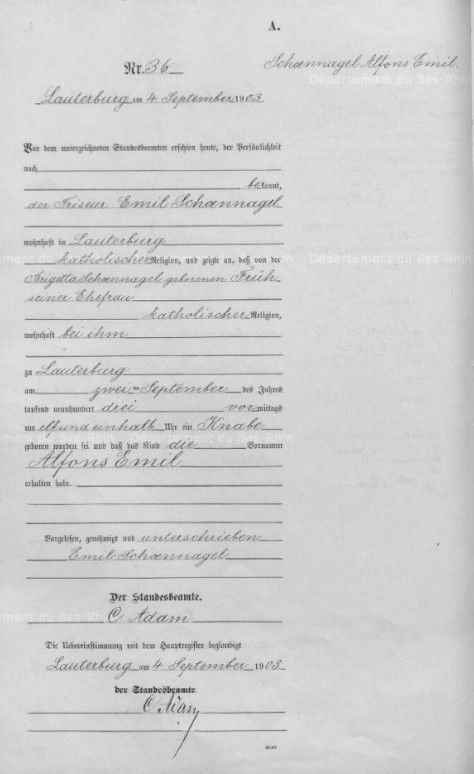
Another four years after this, her son Emil got married at age 29. He married Brigitta Früh, age 23, who was born in Sasbach. Eleven months after their wedding, Alfons Emil was born.
Grandpa didn’t like talking about the years before Ellis Island. His parents, Emil and Brigitta, died 11 days apart when he was 6 years old. The year was 1910.
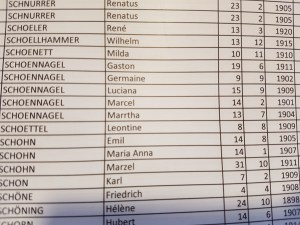 There were five kids with the last name Schoennagel placed in orphanges during the years 1901 to 1911 in the county (or prefecture) of Wissembourg, where Lauterbourg is. None of them were named Alfons or Emil. They were Marcel, Germaine, Marrtha, Luciana, and Gaston. If Grandpa spent any time in an orphanage, it was not in Lauterbourg.
 I found no record of his emigration from Alsace to Baden-Württemburg, even though this movement would’ve been subject to passport control at that time, according to the librarians I spoke with. One librarian suggested I look through the deportation records from 1918-1921, when Grandpa would’ve been 14 to 17 years old. I did, for a few hours. The records would fill most of one bookshelf, and my best guess is they cover about 20,000 people who were expelled by the French government during those years, most of them to Germany. I didn’t find any Schoennagels nor similar names.
The death records for his parents don’t indicate the cause of death. Maybe it was a contagious disease and he was relocated to Sasbach, to the house where his mother grew up, while they were still alive. Somehow he ended up there, because Sasbach was his most recent residence according to his Ellis Island paperwork.
While researching this on Ancestry.com I stumbled onto the family tree of a distant cousin who is active on the website. She is decended from the older sister of Madeleine Schoennagel, Elisabetha “Lisette” Schoennagel. If her Ancestry tree is correct (and I have no reason to doubt it, she clearly invested a lot of work into it), there were Schoennagels living in Lauterbourg since at least the mid-1700s.
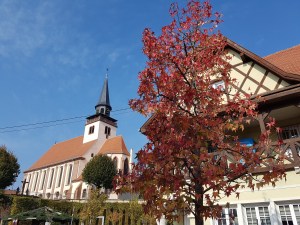
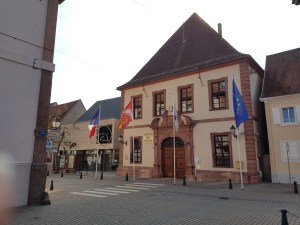
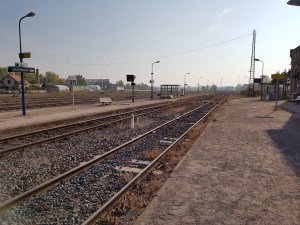 Lauterbourg is nice but there’s not much to it. The part that survived the war is up on a small hill, and consists of a tall church, the town hall, and several houses. The rest of Lauterbourg had to be rebuilt after the war, and it can be summed up as: a few hundred houses surrounded by forests and farms – wheat, some corn, and a few apple trees. The train station is just three unpaved dirt platforms and the building there is closed to the public. A few benches, no restrooms.
I’m left with gaps in Grandpa’s life story: who raised him after age 6, and how did he arrive there? How did he survive whatever took his parents’ lives? It’s a shame I never heard back from anybody in Sasbach, which suggests to me there weren’t very good records kept there 100 years ago, and there’s just nothing to find now.
Maybe Grandpa would’ve wanted it this way. He seems to have been focused on the future, never on the past. If I’d been old enough to ask him about these things, I think he would’ve politely sidestepped each question.
I never met Grandpa. He died a couple years before I was born.
Alfons Emil Schoenagel
2 September 1903 Lauterbourg, Alsace, France
26 February 1976 Troy, New York, USA
Random pictures taken in and between Basel, Switzerland and Stuttgart and Karlsruhe, Germany.


Basel, Stuttgart, and Karlsruhe
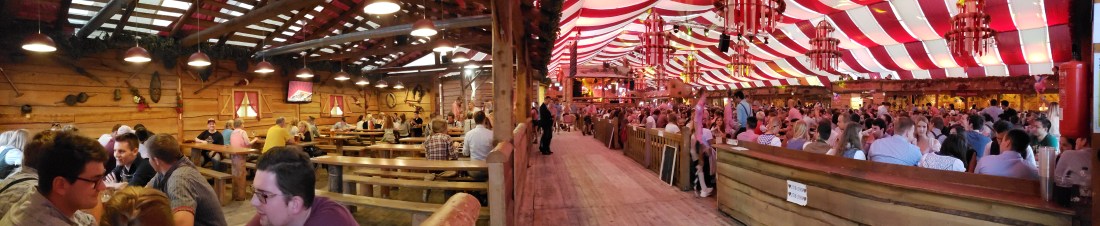
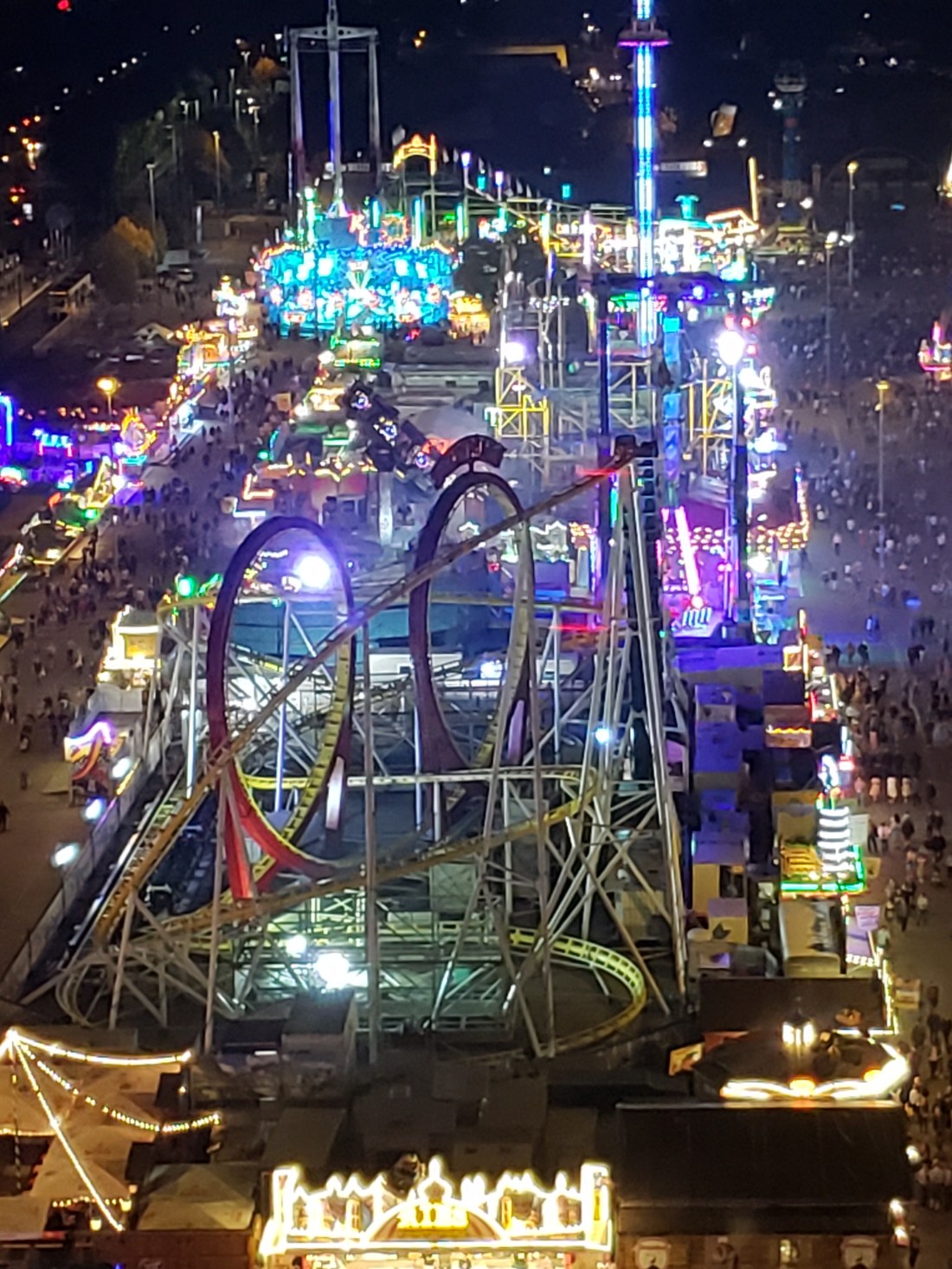
It’s hard to describe a German Volksfest because each visit can be so different, even from one day to the next. Many of the larger towns in southern and in northwestern Germany host one or more Volksfests each year, each lasting from one to three weeks.
Each Volksfest combines a large traveling carnival with a beer or wine festival and a celebration of the regional culture. Some are heavier on the Trachten (the traditional clothing), others not so much.
Depending on your interests, the experience can be like a county fair, like a boozy picnic, like an oldies concert or Schlager concert, like a beer tasting event, or like a Halloween party with old-timey costumes. The largest fest, Munich’s Oktoberfest, is focused on Bavarian culture and beer drinking. The biergarten originated in Munich, and each beer tent is like a biergarten protected from the rain, with a Schlager band or a brass band performing on a stage in the center.
Six years after I went to the Oktoberfest I went to the second largest fest, the Cannstatter Volksfest in Stuttgart. It’s more family-friendly, more of a big state fair and less of a beer festival. Cassie and I went on the Thursday and Friday before closing weekend. A surprising number of people, many of them young, were wearing Trachten on both days. We enjoyed both nights but really noticed a different vibe between the two. On Thursday people were there for the fair, on Friday people were there to drink.
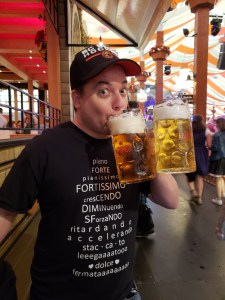 The experience can be whatever you want, and it attracts people of all ages. Each year about 6.5 million people visit the Munich Oktoberfest in mid September to early October, and 4.5 million visit the Cannstatter Volksfest, which starts a week later. About two-thirds of visitors are locals, with half the remainder from other states in Germany and the rest from foreign countries.
The first Cannstatter Volksfest was 200 years ago, in 1818. It was an agricultural festival celebrating the recovery from a widespread famine three years earlier.
Cannstatter Volksfest
Random pictures taken in Lyon, France.


Lyon
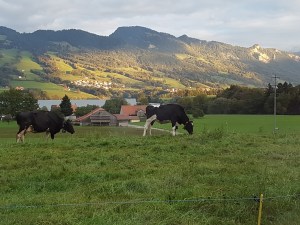 We took a day trip from Fribourg to Gruyères, Switzerland (which Gruyère cheese is named for), and up the nearby mountain, Le Moléson, which is reached by funicular and cable car.
To reach Gruyères from its state (or canton) capital, Fribourg, requires either two trains or one intercity bus, then a train up into the hills, and finally a local bus into the old town. The same local bus route, in the opposite direction, goes from Gruyères train station to the bottom of the Moléson funicular. We started with the mountain because a storm was forecast for the late afternoon.
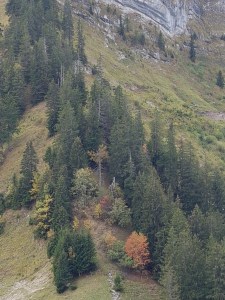
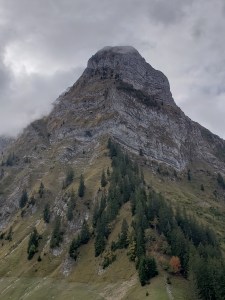 The bus ride climbed enough to make our ears pop while the big leafy trees passed overhead. A few were beginning to change colors but it was still early in the season.
The leafy trees give way to evergreens where the mountainside gets steeper, and that’s where the road ends and the funicular begins.
The tickets we purchased in Fribourg were good for all the buses and trains, but we didn’t know whether that included the funicular. Since it runs only once every 20 minutes, and the operator was planning a trip to California next year, we talked with him for quite a while. “It runs when I press the button so don’t worry. It will wait for you.” So we talked some more.
 (A separate ticket is needed.)
We thought the bus ride had taken us pretty high. Then we thought the funicular took us really high, at a steep rate.
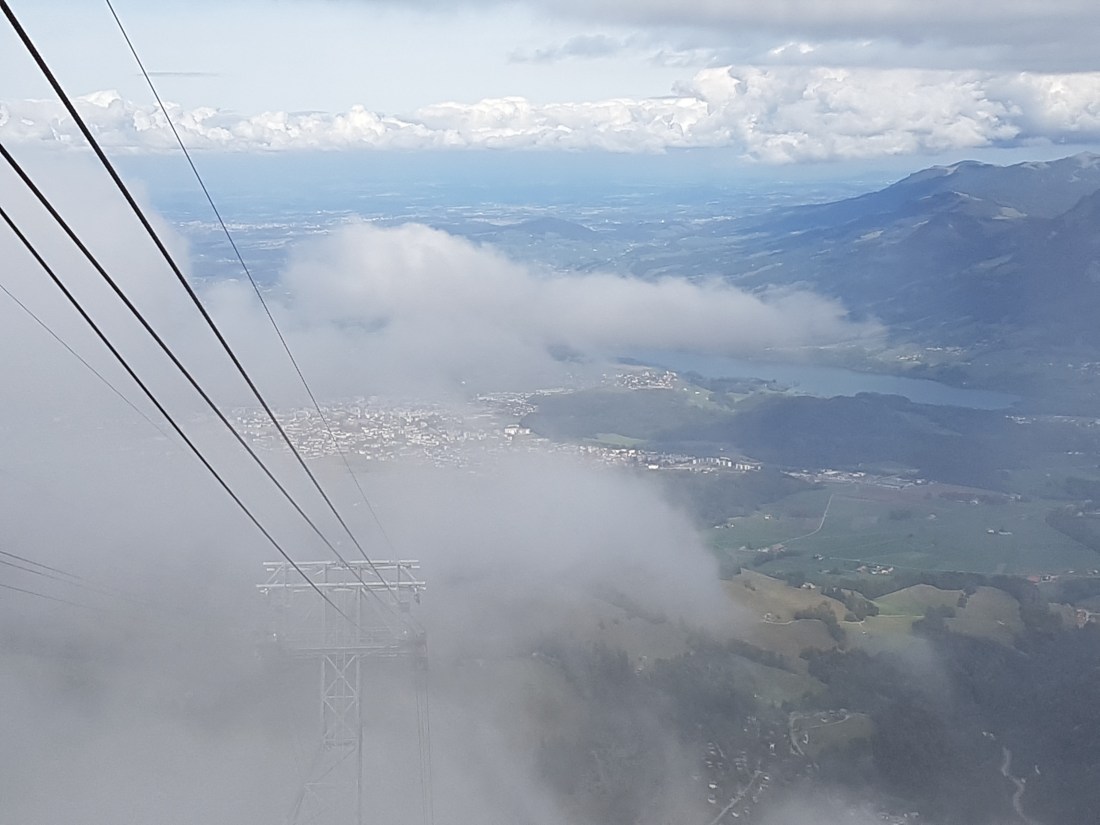
But there were these cables we had seen an hour earlier, way up in the air. We figured there’s no way those are the cable car lines – they must be power lines.
We exited at the top of the funicular, which shares a building with the bottom of the cable car. We stepped outside, looked up, and realized we had underestimated this mountain. At this point Cassie reminded me of her fear of heights.
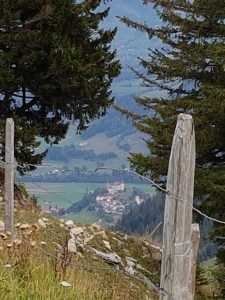 So we walked around for several minutes taking pictures, and occasionally looking up at that cable car. The sound of cowbells can carry very well in the open, thin air. A herd that’s 15 minutes away sounds like it’s 15 feet away, with its cowbells sounding like Alpine folk music from a nearby speaker.
And then we saw a little old lady board the cable car alone, and watched it pull away, leaving us looking up at it.
“Fine,” Cassie said. “Let’s do this.”
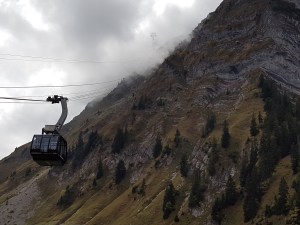 I should say, it’s a more wobbly experience than the funicular. Try not to look down during it.
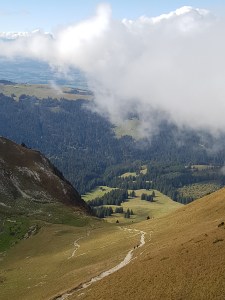
But it’s beautiful at the top. We looked down through the clouds at the town and its nearby lake. All around us there were meadows and stands of trees and bare rocks and passing clouds. Sometimes the sun would peek through them, sometimes a patch of blue. And sometimes on the horizon a faraway lake would peek through.
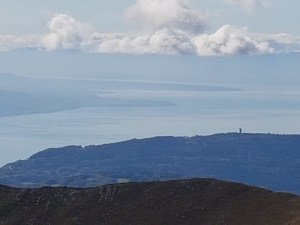 It took us a while to realize we could see Lake Geneva, on the French border about 40 miles away. The cowbells were quieter but still there.
And then a cloud would sneak up on us, and we’d be inside it for a few minutes. The clouds would swirl up, then down, then to the side as they rode the wind between hilltops and over ridges and into valleys.
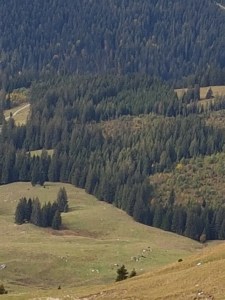 Le Moléson is at the end of a chain of mountains, technically it’s a Prealp or a foothill at the base of the High Alps. It felt much taller than 6,570 feet. It felt like we were on top of the world.
We stepped into the restaurant for a snack and to warm up. Gradually the clouds were keeping out the sun more and more. Maybe there was a storm approaching from behind that ridge, or around that mountain. Couldn’t we see a lake over there earlier?
 It was time to go have some fondue in Gruyères. The cheese pot was served with a meat and pickles platter and lots of bread and little round potatoes. And it was damn yummy.
Funiculì, Funiculà
Random pictures taken between Bern, Fribourg, and Gruyères, Switzerland.



Fribourg and Gruyères
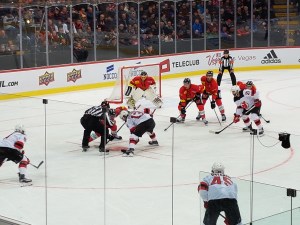
 I had never been to a sporting event in Europe. And I’d never seen a hockey arena with big standing-room-only sections just like a soccer stadium.
Throughout the game, and especially after SC Bern’s late goal to tie the score at 2, the arena was filled with the kind of singing and chanting that I’d only heard on soccer broadcasts before. Most of it came from the upper deck “seats” behind us. I have no idea what they were singing and my cell phone couldn’t really capture it, but it was awesome to hear and that’s all that matters.
Since its founding in 1931, Schlittschuh Club Bern (Ice-skating Club Bern) is 15-time champions of Switzerland’s National League (NL). It is the most attended hockey team in Europe, averaging over 16,000 spectators. Its upper-deck grandstand is the world’s largest within an arena, with a capacity of over 10,000 bench seats.
 When we were making our hotel reservations, we had struggled to find an available hotel in Bern, the country’s capital. I knew that sometimes all its hotels would fill due to a special event.
So Cassie searched the city’s events calendar and found an NHL game was scheduled for one of the nights we wanted to be in Bern. But strangely, there was no ticket information anywhere. Not on the city’s website, not on PostFinance Arena’s site, not on either teams’ sites, and not on the NHL’s site.
We shrugged our shoulders, settled on a hotel further away from the train station, accepted it would be a longer walk than expected (in heavy rain, it turned out), and moved on to making the next hotel reservation. But we would keep an eye out for an ad or a billboard in Bern, anything showing a box office phone number.
And when we arrived there from Italy, and we couldn’t even find that, we got really curious. It felt like the local team was going to play against an NHL club inside a speakeasy, and we were in on the secret. And we wanted to be there when the game started.
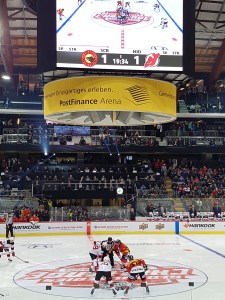 The next morning we rode the tram for 10 exits to look for a ticket office at the arena, several hours before gametime. We wandered up to the arena without knowing where we were going. It was the back side, and there were workers loading the concession stands through the open garage doors. Beyond them, at one corner of the arena we saw a small separate building that looked like a ticket booth. But we couldn’t see its front side and the signs weren’t in English. We walked to it.
Its roll-up doors were rolled down. Ticketing was closed.
We had walked a lot already. We later learned that was because we had used the wrong tram exit.
I peeked around the corner of the arena for more doors. There was something about a third of the way down, it looked like an office door. I told Cassie it would be the last door I would try before giving up. It was our first morning in Switzerland and already we were tired and achy. And sniffly, after walking through the rain last night. We would be fighting off a cold for the rest of the trip.
The door opened when I pulled it, revealing a staircase. Cassie was hesitant to barge into the team offices upstairs, but I really didn’t want to leave empty-handed at that point. We asked for directions to the ticket office and explained we couldn’t find any ticket info anywhere.
“I have four tickets that came back from the NHL I can sell to you. Two are really good and two are on the upper level.”
That’s how we were able to go to the game. Months earlier, it had sold out within just a few days. We figured this was no time to be cheap, so our seats were great (8th row, between the blue lines).
And the game went to overtime.
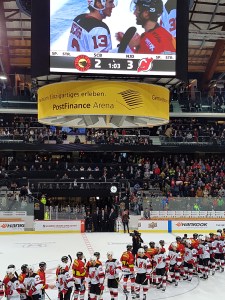
New Jersey Devils 3, SC Bern 2 (OT)
Random pictures taken in and between Milan, Italy and Bern, Switzerland during the first four days of the trip.


Milan and Bern
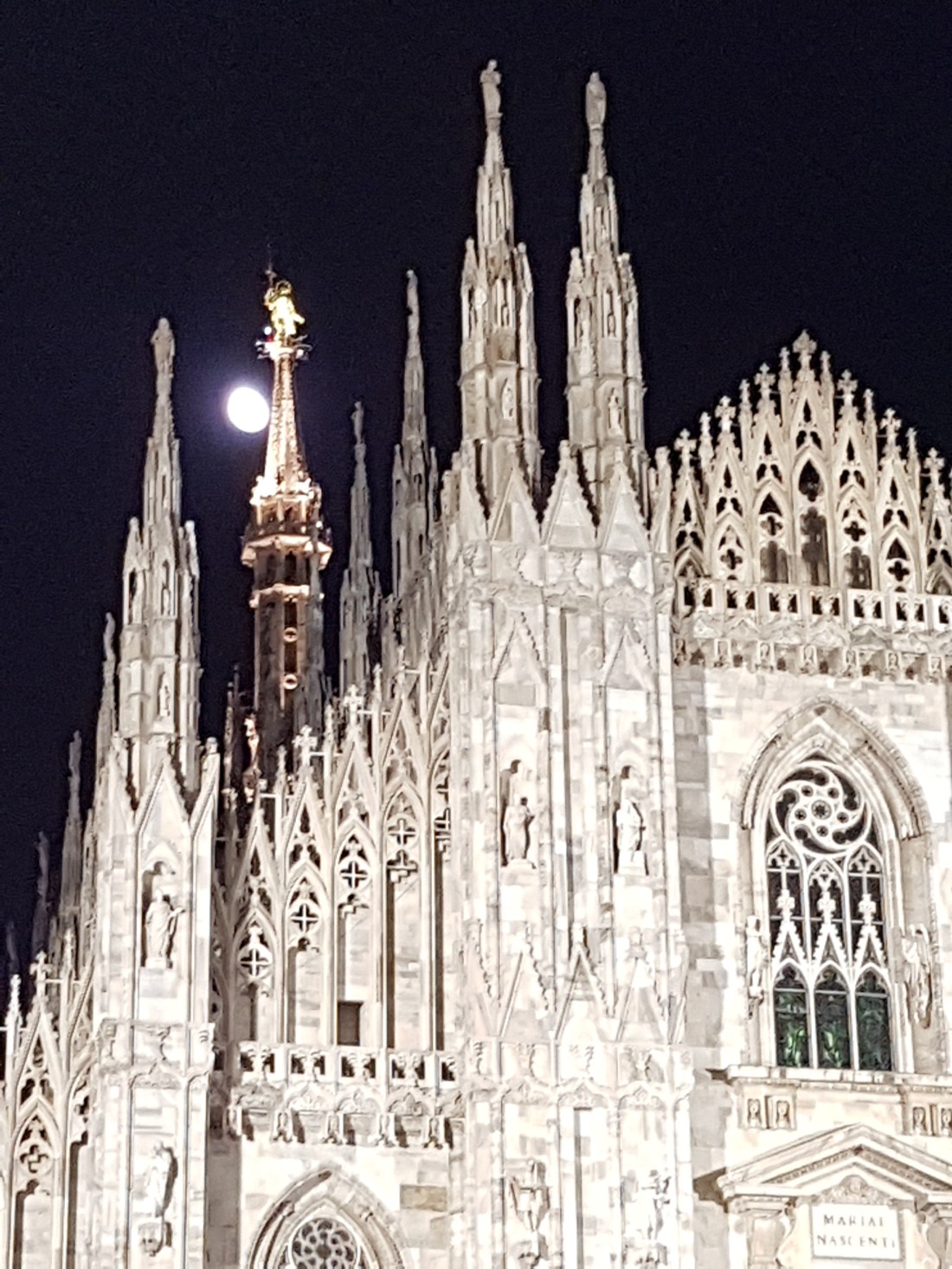
These pictures were taken on the roof of and at the entrances of the Duomo in Milan. Construction began on this cathedral in 1386.


Duomo di Milano
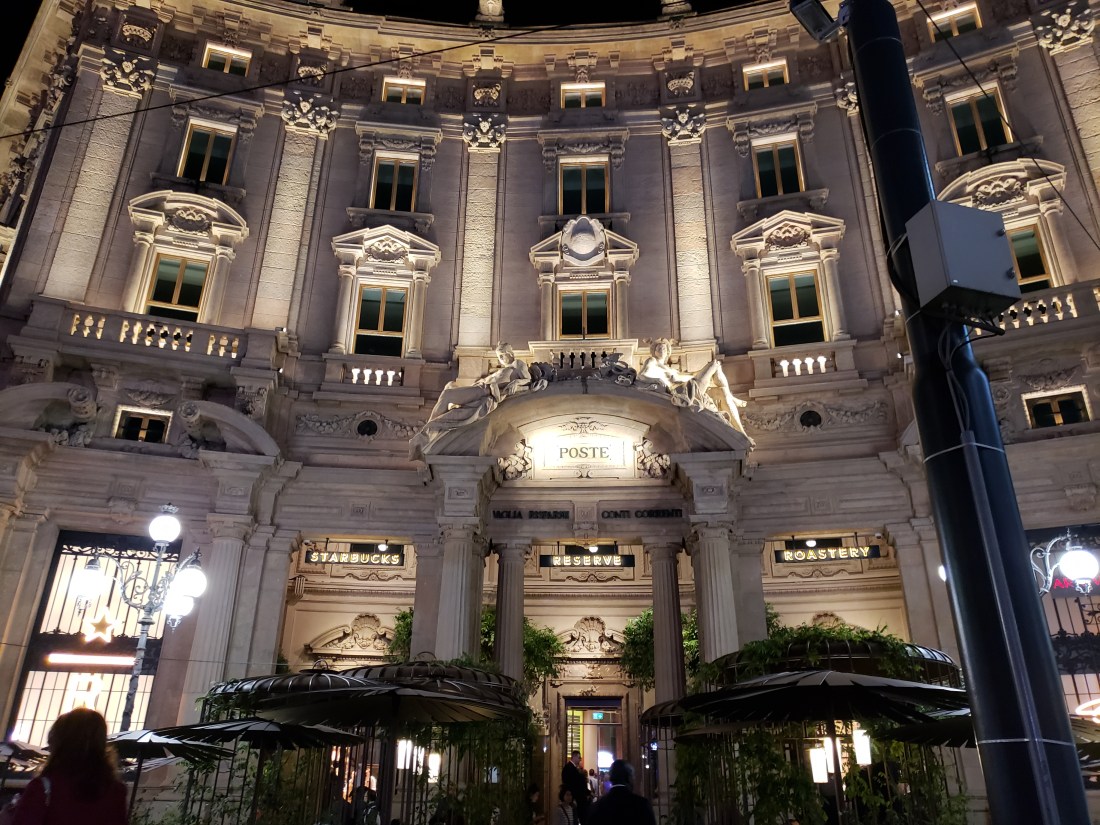
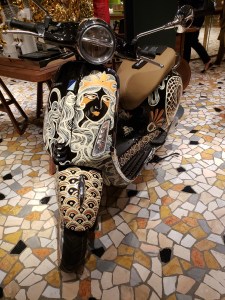 Espresso was invented in Turin and perfected in Milan. The first industrial producer of espresso machines was a workshop in Milan.
The Starbucks chain was inspired by a visit to Milan by its founder, Howard Schultz. The company expanded into 78 countries over the years, but not into Italy until Sept. 6, 2018, 3 weeks before we arrived in Milan.
The new location is 25,000 sq ft. It’s a former post office and stock exchange on the Piazza Cordusio commercial square in central Milan.
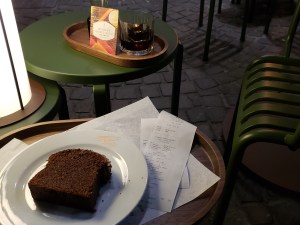 We walked up and were surprised there wasn’t a line of Americans out the door. There were more security guards in suit coats and earpieces than actual customers sitting in the garden patio out front. Inside, however, the lines of customers reminded us of a Disney park. It felt very touristy but like a genuine tribute to Milanese coffee culture, done in an American style.
 Like the other Reserve roastery locations in the US and in Asia, it offers drinks not found at regular stores, including coffee-inspired cocktails and unusual single-origin coffees. There’s also food and dessert options not available elsewhere.
Cassie had a chocolate plum cake (no drink) and I had a whiskey coffee with one giant ice cube. It was a pleasantly warm evening on the patio (the high had been in the low 80s).
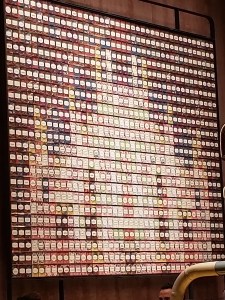
The tea selection is also expansive. A mural of the available tea boxes forms the shape of the Duomo of Milan on one wall.
We arrived shortly before closing so our time on the patio was cut short.
The Starbucks is located about halfway between the Duomo and the Sforza Castle. Each is one Metro stop or a 5-10 minute walk away.
After Starbucks, on the way back to our hotel we went by the Duomo and the Galleria and had drinks at the Mio Lab patio next to the Park Hyatt lobby.
Espresso
 Brian's Travel Blog