
Grandpa didn’t like talking about the years before Ellis Island, where his last name was respelled from Schoennagel to Schoenagel.
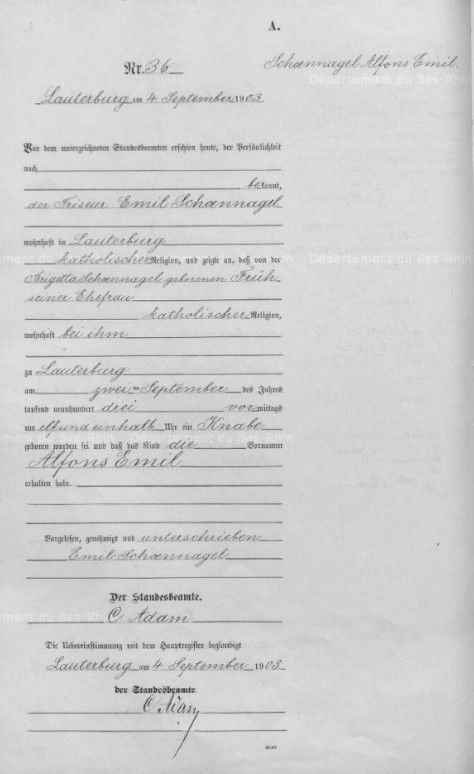 He was 20 years old when he boarded the S.S. America at the port of Bremen, Germany. He had lived most recently in Sasbach, which is a 40 minute drive from where he was born.
Sasbach is small, a little over 5,000 people. His birthplace, Lauterbourg, is half that size. Maybe Lauterbourg was larger before May 1940, when it was destroyed by artillery. These days it has 2,200 people, and it’s been part of France’s department (or state) of Alsace for 100 years now.
I recently turned 40 and I wanted to celebrate by going to Europe. And when I was done sightseeing, I wanted to spend a few days in Alsace seeing where Grandpa was from, and hopefully learning about his years before Ellis Island. In the weeks prior to the trip, I signed up for Ancestry.com and learned about how birth, marriage, and death records were maintained in France and in Germany, and where they would be kept today.
The quality of record keeping varies a lot from one state to the next. It’s a reminder that each department was at one time a separate country or kingdom. But Alsace has good departmental archives in its capital and its records up to 1912 are available online, if you can read their handwriting.
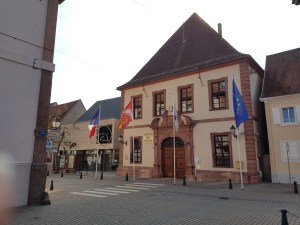
 I contacted the email addresses for the Archives for Lauterbourg (in Strasbourg, Alsace) and in the Civil Registration Office in the town hall of Sasbach, Baden-Württemberg. Alsace replied and Baden-Württemburg never did, so I focused on finding whatever I could in Alsace.
The story I could piece together is not very happy, but here it is:
Grandpa’s father’s mother, Madeleine Schoennagel, was born in Lauterbourg 27 March 1853. When she was 19, she gave birth to a son, Emil Schoennagel, on 13 February 1873. The father was never identified.
A lengthy note was added to the margin of Emil’s birth record. It must have been added when he was 21 years old. The note indicated that Madeleine got married in 1894 (at age 41) to Jacob Bühler, and confirmed that she already had a grown child at the time.
 Four years later, Madeleine died at age 45. The cause is not indicated on her death record.
Another four years after this, her son Emil got married at age 29. He married Brigitta Früh, age 23, who was born in Sasbach. Eleven months after their wedding, Alfons Emil was born.
Grandpa didn’t like talking about the years before Ellis Island. His parents, Emil and Brigitta, died 11 days apart when he was 6 years old. The year was 1910.
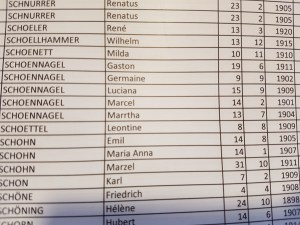 There were five kids with the last name Schoennagel placed in orphanges during the years 1901 to 1911 in the county (or prefecture) of Wissembourg, where Lauterbourg is. None of them were named Alfons or Emil. They were Marcel, Germaine, Marrtha, Luciana, and Gaston. If Grandpa spent any time in an orphanage, it was not in Lauterbourg.
 I found no record of his emigration from Alsace to Baden-Württemburg, even though this movement would’ve been subject to passport control at that time, according to the librarians I spoke with. One librarian suggested I look through the deportation records from 1918-1921, when Grandpa would’ve been 14 to 17 years old. I did, for a few hours. The records would fill most of one bookshelf, and my best guess is they cover about 20,000 people who were expelled by the French government during those years, most of them to Germany. I didn’t find any Schoennagels nor similar names.
The death records for his parents don’t indicate the cause of death. Maybe it was a contagious disease and he was relocated to Sasbach, to the house where his mother grew up, while they were still alive. Somehow he ended up there, because Sasbach was his most recent residence according to his Ellis Island paperwork.
While researching this on Ancestry.com I stumbled onto the family tree of a distant cousin who is active on the website. She is decended from the older sister of Madeleine Schoennagel, Elisabetha “Lisette” Schoennagel. If her Ancestry tree is correct (and I have no reason to doubt it, she clearly invested a lot of work into it), there were Schoennagels living in Lauterbourg since at least the mid-1700s.
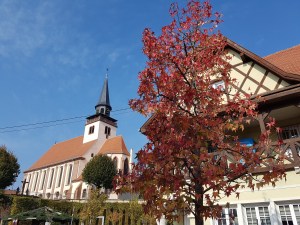
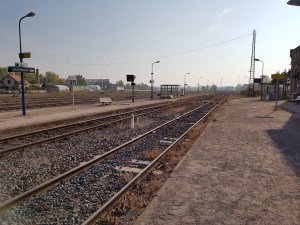 Lauterbourg is nice but there’s not much to it. The part that survived the war is up on a small hill, and consists of a tall church, the town hall, and several houses. The rest of Lauterbourg had to be rebuilt after the war, and it can be summed up as: a few hundred houses surrounded by forests and farms – wheat, some corn, and a few apple trees. The train station is just three unpaved dirt platforms and the building there is closed to the public. A few benches, no restrooms.
I’m left with gaps in Grandpa’s life story: who raised him after age 6, and how did he arrive there? How did he survive whatever took his parents’ lives? It’s a shame I never heard back from anybody in Sasbach, which suggests to me there weren’t very good records kept there 100 years ago, and there’s just nothing to find now.
Maybe Grandpa would’ve wanted it this way. He seems to have been focused on the future, never on the past. If I’d been old enough to ask him about these things, I think he would’ve politely sidestepped each question.
I never met Grandpa. He died a couple years before I was born.
Alfons Emil Schoenagel
2 September 1903 Lauterbourg, Alsace, France
26 February 1976 Troy, New York, USA

 Brian's Travel Blog